http://www.hookecollege.com/courses/index.asp
Course Category:
OR   Industry:

Hooke College of Applied Sciences is always looking to expand our course offerings to better serve you. Don't see what you are looking for? Let us know and we will consider developing a course for your needs. Click here.

Light Microscopy
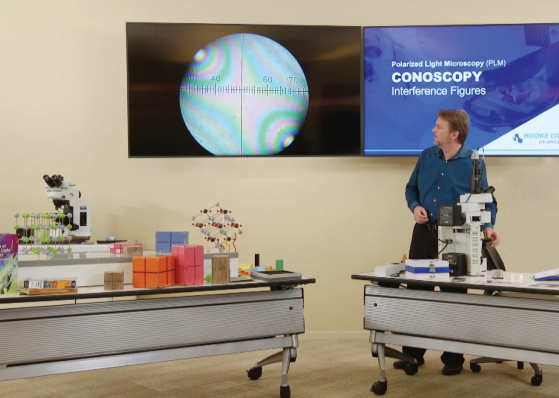
The Modern Polarized Light Microscopy (PLM) covers the theory and principles of polarized-light microscopy more thoroughly than the Special Applications courses. Students learn time-honored and highly specialized PLM methods that can be successfully applied to virtually all materials problem-solving situations... MORE >
Freeze-dry microscopy, as part of a complete thermal analysis study, is an invaluable tool in the characterization of the thermal properties of any formulation. It allows you to save a significant amount of time in money both in process development and in commercial manufacturing... MORE >
Construction, alignment, and set up of the four-axis universal stage, and techniques of measuring planar and optical directions of crystalline materials in thin section using three axes of rotation, is addressed in this class... MORE >

Electron Microscopy
The SEM course emphasizes hands-on learning. Using five SEM and EMA instruments, students have the opportunity to study their own samples, or test samples provided by our staff, under the direction of McCrone scientists with over 40 years of combined SEM/EDS/WDS experience... MORE >
This course in Transmission Electron Microscopy is designed to provide practical, hands-on learning for new and experienced operators. The course utilizes lectures, demonstrations and direct student participation, using a JEOL JEM-3010 300 kV, LaB6 TEM... MORE >
This is an advanced course in x-ray microanalysis using energy-dispersive x-ray spectrometry (EDS). The course will provide instruction and hands-on practice on performing EDS, analyzing difficult samples, mapping, and interpreting analysis results... MORE >
The SEM imaging course is an advanced topics course and provides instruction and hands-on practice for getting the best possible SEM images, especially from difficult samples, or under challenging operating conditions... MORE >

Spectroscopy
This Infrared Microscopy course is designed to provide practical instruction in "real world" use of the FTIR microscope. This course assumes basic knowledge of infrared spectroscopy and operation of an FTIR microscope. There is a brief discussion of infrared theory, and a heavy emphasis on using FTIR microscopy in problem-solving applications... MORE >
This Raman microspectroscopy course is designed to provide practical instruction in "real world" use of the Raman microscope. The class utilizes demonstrations and laboratory exercises supplemented with lectures... MORE >

Imaging/Software
The Electrostatic Detection Apparatus (ESDA), used for indented writing detection, and the Video Spectral Comparator (VSC), for UV/IR imaging in reflection/absorption and fluorescence modes, are two of the most important instruments used in the examination of questioned documents... MORE >
This hands-on workshop deals with the challenges associated with archiving and managing all the digital images and digital files that your organization creates on a daily basis; images that document your work, data basing, communication through reports and presentations, making measurements and perform specific image analysis routines... MORE >

Microscopical Examination & Identification
This USP <788 course covers the United States Pharmacopeia National Formulary Method <788> Particulate Matter in Injections, Microscopic Particle Count Test. This one-day course provides students with a hands-on understanding of the method as well as instruction on how to prepare samples for counting, and performing microscopic particle counts... MORE >
This course is an initial introduction to microscopical trace evidence examination. This course introduces the student to the principles and practical use of the stereomicroscope and polarized light microscope for the analysis of common microscopic trace evidence (hairs, fibers, paint, and glass)... MORE >
This course offers this Special Forensics course as an initial introduction to forensic hair comparison. This course introduces the student to the principles and practice of forensic hair comparison using microscopy and DNA analysis... MORE >
The Fiber Microscopy Course introduces the principles and practice of polarized light microscopy (PLM) to the identification of natural and man-made fibers. The course will be useful to anyone from a variety of sciences needing to identify fibers... MORE >
The Forensic Soil Examinationm Part 1 course covers the forensic examination and comparison of soil. The class emphasizes methods and procedures used in the forensic community for soil analysis. Part 1 covers the forensic aspects of soil analysis, sample handling and processing with only an introduction to mineral identification... MORE >
The Forensic Soil Examination course Part 2 covers the microscopical identification and comparison of soil constituents, concentrating on common soil minerals. The course emphasizes historical and innovative methods and procedures used in the forensic community for soil comparisons... MORE >
The Forensic Paint Identification and Comparison course provides students with an understanding of forensic paint analysis. Students learn the composition of paints, modes of film formation, and the composition of paints as related to their end-use applications... MORE >
Presented as a wide-ranging materials analysis course, students learn about the identification and comparison of basic building materials and the products made from them including wood, paper, cements, plasters, mortars, bricks, blocks, and insulation. MORE >
Most pharmaceutical products are specified to be essentially free of visible particles and there are limits on the number of sub-visible particles allowed. The FDA requires that contamination problems are fully investigated in a timely fashion. This course teaches an analytical approach that utilizes microscopical examination coupled with sample isolation, preparation, and analytical methods optimized for small particles, to successfully identify particulate contamination for regulatory compliance... MORE >
This course in paint materials identification for conservation professionals in paintings and architecture. The focus of this course is the identification of pigments using polarized-light microscopy (PLM). A practical, introduction to PLM methods is taught using many examples from the world of pigments... MORE >
This conservation materials course introduces the student to methods of conservation material identification using materials across all conservation specialties including pigments, paper, fibers, object materials, architectural materials, and inks... MORE >
The "White Powders" course teaches students how to identify white powders using several microscopical identification techniques including: polarized light microscopy (PLM), fluorescence microscopy, spot tests, solubility tests, flame tests, and thermal microscopy... MORE >
This course focuses on the optical characterization of opaque minerals using a polarized light microscope and reflected light. Samples studied will be mostly ore minerals, but the general principles and techniques can be applied across a broad spectrum of metallurgical and other materials... MORE >
Identification of crystalline materials with the polarized light microscope is of importance for those working in forensics, soil science, pharmaceuticals, environmental analyses, analysis of pigments, and earth sciences. This class introduces the student to a range of methods used for the identification of crystalline materials... MORE >
Gunshot residues (GSR) are usually a combination of unburned gun powder, metal fragments and primer resides. These residues are used to help investigate whether a person has been in contact with a fired gun, whether a hole in a garment is an entrance hole or exit hole or help determine the distance between the gun muzzle and target... MORE >
The stereomicroscope is one of the most important tools used by the Forensic Document Examiner (FDE). This workshop provides a strong foundation in the workings of the stereomicroscope and presents a number of practical exercises to enhance the professional Forensic Document Examiner's proficiency... MORE >

Sample Preparation
This course focuses on isolating, mounting, and handling 1-100 µm sized particles without the use of micromanipulators. Methods for isolating contaminants from liquids, solids or on surfaces are covered... MORE >
Taught by members of cleanroom staff at McCrone Associates,specialized techniques will be demonstrated for isolating and mounting contaminants from pharmaceutical and medical devices... MORE >
Taught by members of cleanroom staff at McCrone Associates, specialized techniques will be demonstrated for isolating and mounting contaminants from real-world samples of polymers, paints and coatings... MORE >
Taught by members of cleanroom staff at McCrone Associates, specialized techniques are demonstrated for isolating and mounting small particles and microtraces from examples of trace evidence... MORE >
Taught by members of cleanroom staff at McCrone Associates,specialized techniques is demonstrated for isolating and mounting single particle contaminants and non-bulk material for TEM analysis... MORE >
This course is taught by members of cleanroom staff at McCrone Associates and specializes in the techniques that are used for isolating and mounting spermatozoa from smear slides. The techniques learned in this course are faster and more economical than the equipment required to carry out laser capture micro-dissection... MORE >

Chemistry
This course is designed as a week-long intensive chemistry review for professionals who would like to refresh their knowledge of chemical concepts... MORE >
This course is based on the accumulation of research and development from a wide range of testing protocols and is focused on the needs of conservators. MORE >

Laboratory
We are pleased to offer a course in instrumentation specifically for laboratory directors and conservation professionals who need to become more familiar with the processes, capabilities, and limitations of certain instrumental techniques, but do not necessarily use them first hand.... MORE >
This course is designed to give a brief introduction to the potential hazards and risk involved in working in a laboratory, handling chemicals, and operating equipment, including how to prevent laboratory accidents, how to minimize exposure to potential hazards and how to safely dispose of materials... MORE >

Education
Each participant receives a Motic compound microscope with a built-in digital camera and archiving software ($500 value). They also receive a book of experiments written by our Scientific Advisor specifically for the Motic microscope. MORE >
The Forensic Workshop is designed to help Middle and High School science teachers develop forensic science lessons to use in their classrooms. The teachers will learn time-honored and specialized forensic science methods... MORE >

Hooke College of Applied Sciences is always looking to expand our course offerings to better serve you. Don't see what you are looking for? Let us know and we will consider developing a course for your needs. Click here.


Copyright ©2010 Hooke College of Applied Sciences